You have completed the Gender-Science Study
Thank you for participating.
Your result on the Implicit Association Test (IAT) is reported below
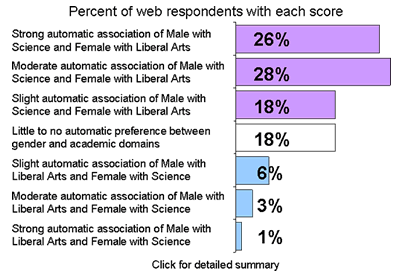
Your data suggest a moderate association of Male with Science and Female with Liberal Arts compared to Female with Science and Male with Liberal Arts.
If your performance is described as '(slight, moderate, or strong) association of Science with Male and Liberal Arts with Female' compared to the alternative pairings, it means you responded faster when Science and Male words were classified with the same key than when Liberal Arts and Male items shared a key. If your association was stronger for 'Liberal Arts with Male/Science with Female' you were faster when using the same key for Liberal Arts and Male items.
Just below is a breakdown of the scores generated by others. Most respondents find it easier to associate Male with Science and Female with Liberal Arts compared to the reverse. The order in which IAT components are administered (i.e., stereotypical category pairings first or second) can make a small difference in some IATs. Because of this order effect, the orders used for IATs presented on this website are assigned at random. In any summaries of data that we present, we make sure that half the test-takers got the A-then-B order and the other half got the B-then-A order. Order has only a minimal influence on task performance.
Researchers are just beginning to learn how implicit gender-science and gender-math associations develop and relate to behavior. We have found that women who identify themselves with math-science domains tend to have weaker stereotypical associations than women who are not math-science-identified, while men show the opposite pattern. A recent study of college women enrolled in calculus found that those with stronger implicit associations of math-as-male at the beginning of the semester, coupled with a relatively strong female gender identification, achieved lower final grades, even after taking into account their previous achievement.
Our laboratory is engaged in a long-term project, The Full Potential Initiative, following the development of implicit academic attitudes and their effects among teenagers, their teachers and parents. Funded by the National Science Foundation (REC-0634041), we're cooperating with various middle and high schools around the country to identify factors associated with change in implicit attitudes and resiliency in the face of academic challenge.
If you have any questions about this study, please contact the primary investigator, Fred Smyth ( fsmyth@virginia.edu).
The gender-science study is one of approximately 100 studies currently on the Project Implicit Research Site to which you can be randomly assigned. You are welcome to complete as many sessions as you wish, and every session will involve a different topic. Some will be topics you have thought about many times, others might be new or unusual topics that you have not considered before. Just return to the login page and enter your email address to start again.
If you have unanswered general questions about the study, please review background information about this research and follow the links to the questions of specific interest to you. Thanks again for your participation. |